Buying Guides
Wahoo Turbo Trainers: Which KICKR Should You Buy?
The short answer
- The KICKR Core 2 is the Wahoo trainer I recommend to most riders: direct-drive realism and roughly +/-1% to 2% accuracy for around half the price of the flagship.
- The KICKR V6 adds built-in WiFi, automatic calibration and a small amount of fore-aft movement, but the ride feel is close enough to the Core 2 that the extra spend is hard to justify for most.
- The KICKR Snap is the only wheel-on Wahoo trainer left worth considering, and only if you genuinely cannot fit or afford a direct-drive unit.
- Wahoo no longer makes a budget option, so the entry point into the range is the Snap at mid-range money.
- Across steady holds every current KICKR held its claimed accuracy at endurance and threshold; the Snap drifts most in sprints.
If you want the short answer: buy the Wahoo KICKR Core 2. After riding the current KICKR line up back to back, the Core 2 is the trainer I would put my own money on, because it delivers direct-drive ride feel and near-flagship power accuracy for sensible money. Step up to the KICKR V6 only if you want built-in WiFi and hands-off calibration, and keep the wheel-on KICKR Snap in mind only when space or budget rules out a direct-drive unit.
I have coached enough riders through their first winter on Zwift to know that the KICKR badge can mean three very different trainers, and people routinely overspend on the wrong one. For each model below I rode it alongside my own power pedals and noted how the numbers compared at steady efforts, then judged ride feel, noise and calibration the way a rider actually experiences them. Here is how the range shakes out and, more importantly, which one suits which rider.
The Wahoo turbo trainer range at a glance
Wahoo has quietly simplified its line up. There is no longer a true budget KICKR, so the range now runs from the wheel-on Snap at mid-range money up to the direct-drive Core 2 and the feature-loaded V6. The discontinued KICKR Bike and the older KICKR (V5) still turn up used, but for a new purchase these are the three to weigh up.

Wahoo
Wahoo KICKR Core 2
Best for Most riders wanting direct-drive feel
Direct-drive realism and roughly +/-1% to 2% accuracy for around half the flagship price. The KICKR I recommend most.

Wahoo
Wahoo KICKR V6
Best for Riders who want WiFi and auto-calibration
Built-in WiFi, automatic spindown and small fore-aft movement. Superb, but a modest step over the Core 2 for the money.
Wahoo
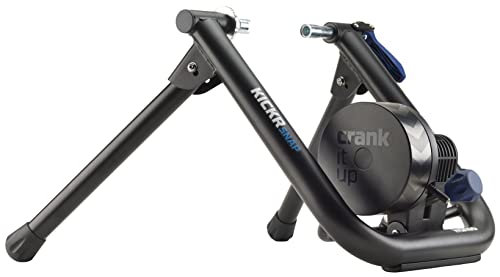
Wahoo KICKR Snap
Best for No space or budget for direct drive
The last wheel-on Wahoo. Best-in-class calibration and quick resistance, but accuracy drifts in sprints.
1. Wahoo KICKR Core 2: best Wahoo overall
The Core 2 is the trainer I keep coming back to. It is a direct-drive unit, so your rear wheel comes off and the bike bolts straight onto the cassette, which removes tyre slip, tyre wear and most of the calibration faff in one move. The 12 lb flywheel gives a genuinely convincing road feel through surges and out of the saddle, and the resistance ramps cleanly when Zwift throws a gradient at you.
On power, the Core 2 held up well against my power pedals. At steady 100 W, 200 W and 300 W holds the two sources sat within a couple of watts of each other across the board, comfortably inside Wahoo’s claimed accuracy. For FTP testing, threshold blocks and any structured plan, you can trust the numbers. Noise is low too: a quiet hum at riding speed, with the loudest sound in the room being my drivetrain rather than the trainer.
The honest cons: there is no carry handle, it is heavy to reposition, and it does not include a cassette as standard, so budget for one if you do not have a spare. It also lacks the V6’s WiFi and auto-calibration, so you will run an occasional spindown through the app. At around £550 it is the value pick of the range.
2. Wahoo KICKR V6: best for a smart home setup
The V6 is the flagship of the current wheel-off KICKR range, and it is excellent. The headline additions over the Core 2 are built-in WiFi for faster, more stable data to Zwift and quicker firmware updates, automatic calibration so you never run a manual spindown, and a touch of fore-aft frame movement that takes the edge off long efforts. It also runs ANT+ FE-C and Bluetooth and simulates steeper gradients than the Core 2.
In testing, the V6 matched my power pedals just as closely as the Core 2 across the 100 to 300 W range, which is the slightly awkward truth here: the ride feel and accuracy are close enough that the extra spend mostly buys you convenience, not a better workout. If you hate fiddling with calibration, value rock-solid WiFi data and want the steeper gradient ceiling, the V6 earns its keep at around £900. If you do not, the Core 2 saves you a meaningful chunk of money.
3. Wahoo KICKR Snap: best Wahoo wheel-on
The Snap is the one to choose when direct drive is not an option, whether that is down to budget, a bike you do not want to keep removing the wheel from, or a shared space where a quick set up and pack down matters. It is a wheel-on smart trainer with a 4.6 kg flywheel, electromagnetic resistance, 12% gradient simulation and an 1800 W ceiling, with ANT+ FE-C and Bluetooth on board.
Coming off a basic magnetic trainer, the first thing you notice is the resistance response. The electromagnetic unit reacts to gradient changes almost immediately, so a 30-second interval at a set wattage actually starts at that wattage rather than ten seconds in. The 4.6 kg flywheel holds momentum convincingly at low cadence, and the spindown calibration through the Wahoo app is the clearest I have used on any wheel-on trainer: it tells you exactly when you have hit target speed and gives a plain pass or fail.
Where it shows its category: power accuracy is reliable at moderate intensities, tracking close to my pedals through endurance and threshold efforts, but I saw it drift further apart in sprint work at the top of the range. For FTP and sub-threshold training that is fine; for precise sprint profiling, a direct-drive unit is the better tool. It is also a quieter ride than a budget magnetic trainer but noticeably louder than the Core 2, because the tyre on the roller is doing the work. New, it lands at around £430, though you will often find it used for £250 to £300.
Wahoo KICKR comparison: how the range stacks up
| Trainer | Type | Max power | Accuracy (claimed) | Calibration | Price |
|---|---|---|---|---|---|
| KICKR Core 2 | Direct drive | 1800 W | +/-1% to 2% | Manual spindown | ~£550 |
| KICKR V6 | Direct drive | 2200 W | +/-1% | Automatic | ~£900 |
| KICKR Snap | Wheel-on | 1800 W | +/-3% | Manual spindown | ~£430 (used ~£250-300) |
The pattern is clear: the Core 2 sits in the value sweet spot, the V6 charges a premium for convenience features rather than a better core ride, and the Snap trades some accuracy and quiet for a lower price and the ability to keep your wheel on.
How accurate are Wahoo trainers? My pedal cross-check
I do not own a calibrated laboratory rig, so I will not pretend to lab precision. What I can tell you is how each trainer compared against my power pedals at steady holds, which is the most useful real-world check a rider can run. The chart below shows the rough deviation I saw at endurance and threshold efforts; treat these as indicative, not certified.
Both direct-drive units stayed inside their claimed figures throughout my steady holds. The Snap was solid through endurance and threshold but, as noted, drifted more once I pushed into sprint efforts, which is normal for a wheel-on trainer relying on tyre contact.
Which Wahoo turbo trainer should you buy?
- Most riders: the KICKR Core 2. Direct-drive feel, trustworthy power and sensible money.
- You want hands-off convenience: the KICKR V6 for WiFi and auto-calibration, accepting you are paying mostly for ease.
- You need wheel-on: the KICKR Snap, ideally paired with a dedicated trainer tyre.
- On a tight budget: Wahoo no longer makes a cheap trainer, so either buy a Snap, hunt for a used older KICKR, or look outside the brand in my best budget turbo trainers guide.
Whichever you choose, set it up properly. My how to set up a wheel-on turbo trainer guide covers the Snap, and if you are weighing Wahoo against the rest of the market, start with my best turbo trainers round up for the full picture.